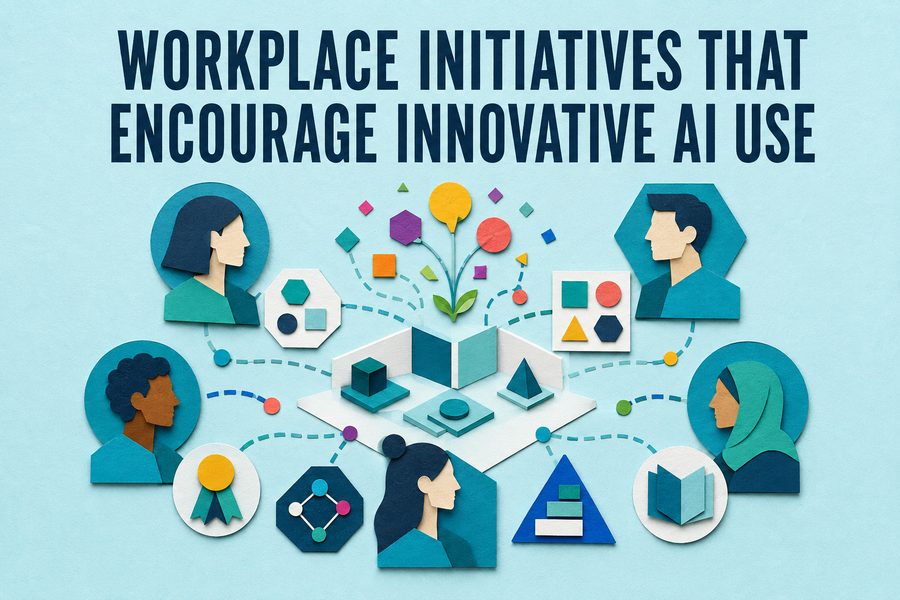
Workplace Initiatives That Encourage Innovative AI Use
About this resource
Access is not adoption. Most organizations that have bought licenses and run a training session discover a few months later that usage has settled close to where it started, and conclude that their people resisted it. They almost never did. Nothing in the working week changed to require it, and nobody said out loud that it was genuinely expected. This free AI adoption playbook sets out nine internal initiatives that close that gap, from recurring use case showcases and responsible innovation challenges to an AI champions program, workflow-before-tool improvement labs, protected experimentation time, an internal knowledge library, an ethics-first reflection program, leadership-sponsored pilots, and share-out sessions built around what people learned the hard way.
Each initiative includes specific recognition mechanisms and a plain statement of why it works, so a leadership team can pick two and start this quarter rather than debating a strategy. None of them require new budget, and most live inside meetings that already exist.
Internal initiatives, each with defined recognition mechanisms. They are built to develop a workforce that can think critically, act responsibly, and improve continuously with AI as a tool rather than a crutch.
How to use it
Pick two initiatives and start this quarter. Organizations that attempt all nine at once complete none of them. These are designed to reward learning, diligence, and shared insight alongside innovation, which is what makes AI adoption durable, ethical, and strategically valuable rather than a spike that fades by week six.
Inside the download
Recurring showcases turn private wins into shared capability across departments.
Time-bound challenges with clear guardrails on data sensitivity and verification.
An AI champions program reduces dependency on external consultants, including us.
Improvement labs that map the process first and only then ask where AI helps.
Common questions
Give explicit permission, protect time to practice, publish which tools are approved, and have managers ask about it in the ordinary one-to-one. The most common reason careful employees do not use AI is that nobody told them they were allowed. Recognition programs, champions, and showcases then convert individual use into shared capability.
Employees from different departments are selected and trained as local AI resources for their teams. Champions receive deeper instruction on approved tools, governance standards, and practical use cases, then host office hours, peer learning sessions, or informal consultations. It builds internal capacity and normalizes adoption by meeting employees where they are.
Because nothing in the daily job changed to require it. Skill without application decays quickly, so usage typically peaks two or three weeks after a workshop and returns near baseline by week six unless a workflow was redesigned, time was protected, and a manager keeps asking about it.
Free. No email list, no follow-up sequence.
More from the resource library, chosen because they pair well with this one.
A structured guide to clarify readiness, goals, and risks before any AI investment is committed.
Creative ideas for AI use outside the workplace, where the stakes are low and the confidence gets built.
Customizable prompt templates for customer service, administration, healthcare, retail, finance, and field operations.
Tell us a little about yourself and this document is yours. We don't have an email list. We collect this so we know who's finding our resources useful, and that's it.
You're downloading
this document
Your information is kept confidential and never shared with anyone.