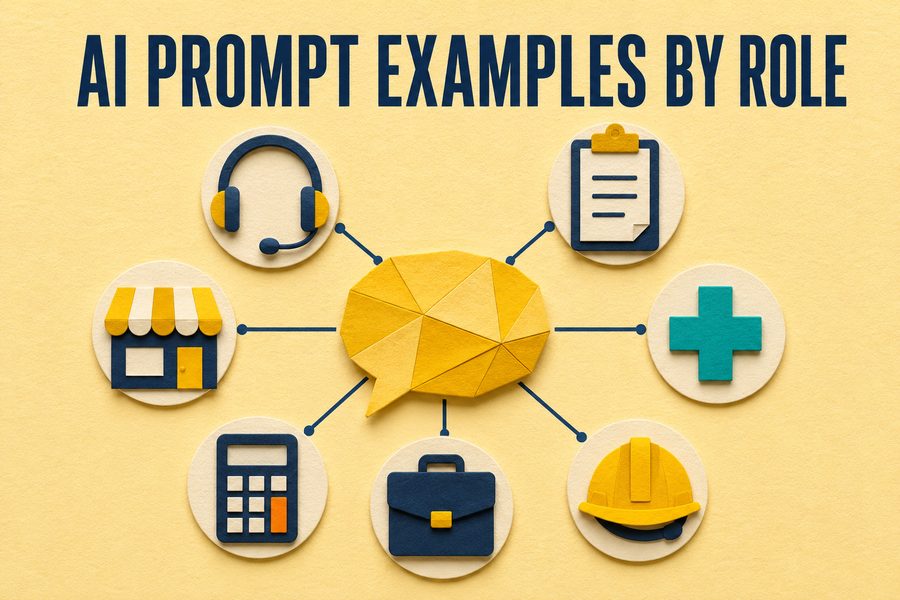
AI Prompt Examples by Role
About this resource
The most common reason AI training does not stick is that the examples came from somebody else’s job. A generic demonstration is impressive in the room and useless on Monday, because the person watching cannot name what they would use it for. This free collection of AI prompt examples by role fixes the relevance problem by organizing templates around the work people actually do.
It covers customer service, administration and operations, healthcare, retail, finance, and field operations, plus a set of universal prompts that apply to almost any role. Every template is written to be customized rather than copied verbatim, with the variable parts marked so a person can drop in their own situation. It is the handout to give someone who has been told AI will help them and has no idea where to begin.
Plus a universal set. Training built on generic examples produces agreement in the room and no change in the work, because relevance is what decides whether anything survives the week.
How to use it
Give it to one person and ask them to try two prompts from their own section this week. Adoption spreads through a colleague in the same role solving a familiar problem, which transfers faster than any course because the relevance is already established. Once a few templates prove useful, collect the ones your own people write and the library becomes yours rather than ours.
Inside the download
Six role families covering the functions most organizations actually staff.
Templates you adapt rather than a blank box and a blinking cursor.
Drafting, summarizing, rewriting, and preparing, which apply to nearly every role.
Why generic training fails and role-specific examples do not.
Common questions
The best starting prompts are the ones attached to a task you already do weekly. Drafting correspondence, summarizing a long document, rewriting something for a different audience, preparing questions before a meeting, and turning notes into a structured summary are useful across nearly every role and carry low risk.
Start from a template built for your role, then add the three things a model cannot infer: who you are writing for, what constraints apply in your organization, and what format you need back. Role-specific templates work because they already contain the shape of the task, leaving only your context to add.
Because relevance decides whether anything survives the week. A single session delivered to accountants, case workers, and schedulers alike teaches everyone a little and nobody enough. Training built around the tasks each role performs weekly produces change that persists after the enthusiasm fades.
Free. No email list, no follow-up sequence.
More from the resource library, chosen because they pair well with this one.
Six before-and-after prompt pairs that show exactly what changes when a vague request becomes a specific one.
A curated guide to external courses, prompt libraries, and role guides, each with a note on who it actually suits.
Nine internal initiatives that turn access into adoption, each with recognition mechanisms and the reason it works.
Tell us a little about yourself and this document is yours. We don't have an email list. We collect this so we know who's finding our resources useful, and that's it.
You're downloading
this document
Your information is kept confidential and never shared with anyone.