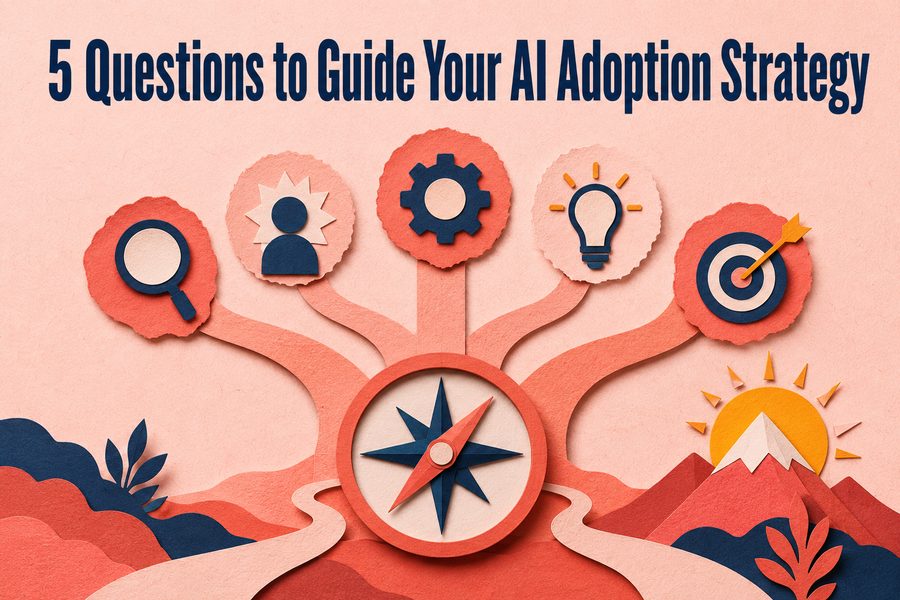
5 Questions to Guide Your AI Adoption Strategy
About this resource
Most AI initiatives fail long before the technology does. They fail in the gap between the decision to invest and the first honest conversation about what the organization is actually trying to fix. This free AI adoption strategy worksheet gives leadership teams five questions that surface that gap while it is still cheap to close, covering the specific problems AI is meant to solve, what your workforce actually believes about it, what success looks like ninety days after training, who has been left out of the conversation, and what support has to exist once the workshop ends.
Each question comes with a short explanation of why it matters and a note on what a good answer sounds like, so a team can work through the whole thing in a single meeting. It is built for the moment before a budget is committed, when the answers are still honest and the plan can still change.
Most leadership teams can answer questions one and three in a sentence. Very few can answer question two without guessing, and question two is usually the one that decides whether the other four matter.
How to use it
Run the five questions independently with your leadership team before anyone discusses them, then ask three or four frontline staff the same questions. The disagreement that surfaces is the output. Where a leadership team gives five different answers to question one, no amount of training or tooling will fix what is actually wrong, and knowing that before you spend is worth considerably more than the price of the meeting.
Inside the download
Move from "we want to be more efficient" to a named process, a named owner, and a rough current cost.
Find out whether leadership’s read on staff sentiment has ever been checked against staff.
Set the measure before the result, using a number the organization already tracks.
Identify whose daily work changes and whether they were in the room when the decision was made.
Common questions
Before investing in AI, a leadership team should agree on the specific problems AI is meant to solve, understand how employees currently feel about AI and why, define what success looks like ninety days after initial training using a measure the organization already tracks, identify who needs to be involved and who has been left out, and decide what support the team will need once training ends.
Measure against a baseline captured before anything changes, using a metric that already exists in a system somebody already reviews. A measure invented for the initiative tends to be abandoned within two quarters. Hours saved, error and rework rates, and cycle time on a named process are all defensible; licenses deployed and self-reported time savings are not.
Both leadership and the frontline staff whose daily work changes. AI adoption affects every level of an organization, and including frontline staff keeps the effort anchored to real workflows. The people whose work changes are frequently absent from the decision and always present in the failure.
Free. No email list, no follow-up sequence.
More from the resource library, chosen because they pair well with this one.
Nine internal initiatives that turn access into adoption, each with recognition mechanisms and the reason it works.
A curated guide to external courses, prompt libraries, and role guides, each with a note on who it actually suits.
Ten questions to answer before the purchase order, eight questions for the vendor, and four honest options including doing nothing.
Tell us a little about yourself and this document is yours. We don't have an email list. We collect this so we know who's finding our resources useful, and that's it.
You're downloading
this document
Your information is kept confidential and never shared with anyone.