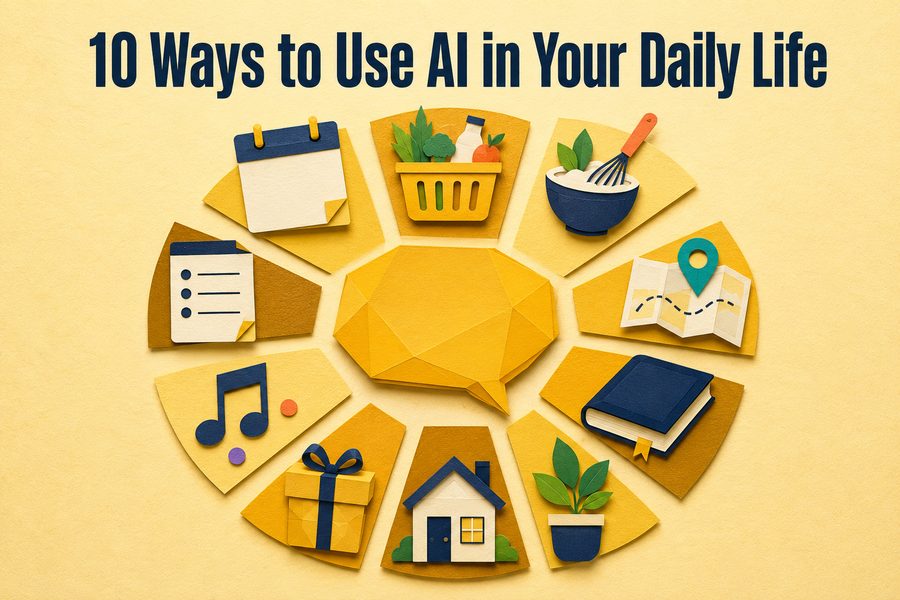
10 Ways to Use AI in Your Daily Life
About this resource
The people who adopt AI at work most easily are almost never the most technical. They are the ones who already used it for something unimportant, developed a feel for where it is strong and where it invents things, and stopped being impressed by it. This free guide gives your team ten low-stakes places to build that instinct, covering meal planning, personal messages, travel itineraries, learning new subjects, home organization, creative projects, financial decisions, fitness, everyday troubleshooting, and rehearsing difficult conversations.
It also carries two rules that matter more than the ideas themselves: what never needs to go into a prompt, and which categories of answer have to be verified before you act on them. Low stakes is not the same as no stakes, and learning the difference at home is considerably cheaper than learning it at work.
Personal use is low stakes, not no stakes. Describe the situation rather than the identity, and verify anything involving health, money, or safety before you act on it.
How to use it
Hand it to a team that has just been given access to a tool and does not yet know what to do with it. Confidence is built through repetition on things that do not matter, and it takes a few evenings rather than a training program. Staff who arrive at a workshop having already used these tools ask better questions and carry less anxiety into the room.
Inside the download
Ten places where a wrong answer costs nothing and the learning still transfers to work.
Practice describing a situation without identifying anyone, before it matters.
A plain rule for which categories of answer need checking against a real source.
A non-threatening entry point for staff who have not started and will not say so.
Common questions
Generally yes, provided you leave out information that identifies you or anyone else. There is rarely a reason to include your full name, address, account numbers, or medical records. Describe the situation rather than the identity and the quality of the answer will be the same.
No. Every use case in this guide works on the free tier of the major assistants. Paid tiers offer faster responses and higher usage limits, which matter more for sustained work than for occasional personal use.
Assume specifics may be invented, particularly dosages, legal requirements, prices, and dates. For low-stakes tasks such as meal planning or gift ideas, being wrong costs nothing. For anything involving health, money, or safety, verify against a real source before acting.
Free. No email list, no follow-up sequence.
More from the resource library, chosen because they pair well with this one.
A curated guide to external courses, prompt libraries, and role guides, each with a note on who it actually suits.
Nine internal initiatives that turn access into adoption, each with recognition mechanisms and the reason it works.
Common beliefs about AI set beside what is actually true, including the ones that turn out to be correct.
Tell us a little about yourself and this document is yours. We don't have an email list. We collect this so we know who's finding our resources useful, and that's it.
You're downloading
this document
Your information is kept confidential and never shared with anyone.