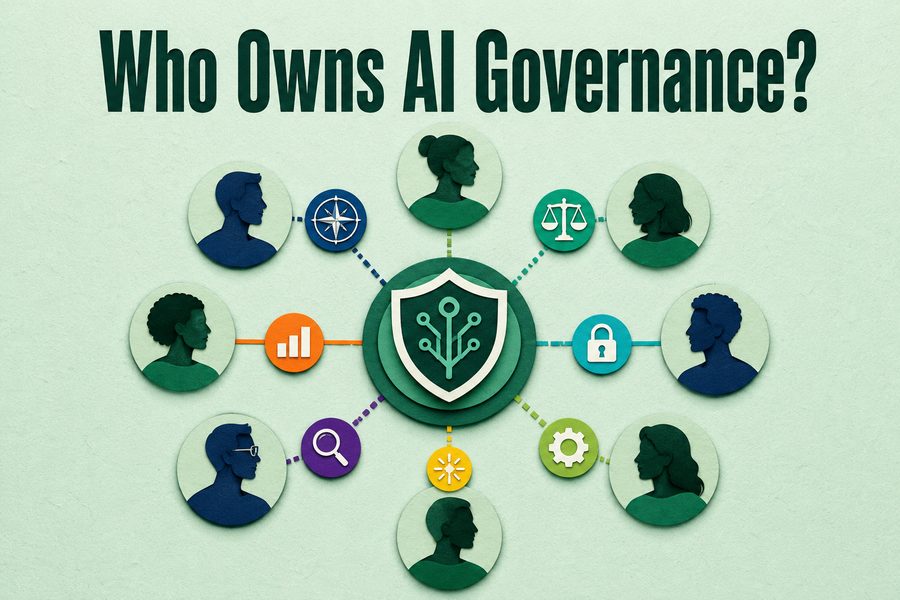
Who Owns AI Governance?
About this resource
Ask five leaders in the same organization who owns AI governance and you will get five answers: IT, legal, the innovation team, whoever ran the last training, and a shrug. Each is partly right, which is exactly why nothing happens. Distributed responsibility with no named owner is functionally the same as no responsibility at all.
This guide maps what belongs to whom across seven groups: executive leadership, IT and security, legal and compliance, HR and people teams, operations and process owners, managers, and every employee. Each entry names the specific duties and the characteristic way that group’s ownership goes wrong. It includes four questions that expose the gap in a leadership meeting, a fill-in page for the four names and two dates that have to exist, and an assessment of three governance structures including the one that reliably does not work.
One person, by name, owns AI governance for the organization. Not a department, not a rotating committee chair, not the leadership team. Everything else assumes that name exists.
How to use it
Name the owner. Everything else can be sequenced afterward and none of it happens without that first decision. The right person is usually not the most technical one available; it is the one with enough organizational standing to say no to a department head and enough proximity to the work to know when saying no is wrong. Then give them the other names, a review date, and a standing item on an agenda somebody already attends.
Inside the download
What executives, IT, legal, HR, operations, managers, and employees each own.
IT owning the decision rather than the assessment, legal handed the whole thing, HR silent on evaluation.
Four questions where the pause before somebody answers is the finding.
Governance owner, tool approver, question answerer, incident recipient, training owner, review date.
Common questions
One named person with enough organizational standing to say no to a department head and enough proximity to the work to know when saying no is wrong. Not a department and not a rotating committee chair. That person then draws on IT and security for technical assessment, legal for obligations, HR for the workforce dimension, and operations for the work itself.
Executive leadership owns the position and the resources. IT and security own the technical assessment and account configuration, not the decision about whether the work needs a tool. Legal owns obligations and language review. HR owns the training commitment and the boundary between capability and performance. Operations owns the workflow. Managers determine whether any of it happens. Employees own the output that carries their name.
Under roughly 200 people, a single named owner consulting the other functions as needed. Above that, a small standing group of four or five with one member named as owner and empowered to decide between meetings. The structure that reliably fails is the large consensus committee where no individual can act alone, because it produces a backlog that employees read as a prohibition.
Free. No email list, no follow-up sequence.
More from the resource library, chosen because they pair well with this one.
How well-intentioned rules push AI usage somewhere you cannot see it, and how to find out how much of it you already have.
Where human judgment still matters, three levels of stakes, and what review actually has to mean at each one.
Nine things that decide whether any of this takes hold, and a ten-item leadership self-check scored on evidence rather than intent.
Tell us a little about yourself and this document is yours. We don't have an email list. We collect this so we know who's finding our resources useful, and that's it.
You're downloading
this document
Your information is kept confidential and never shared with anyone.