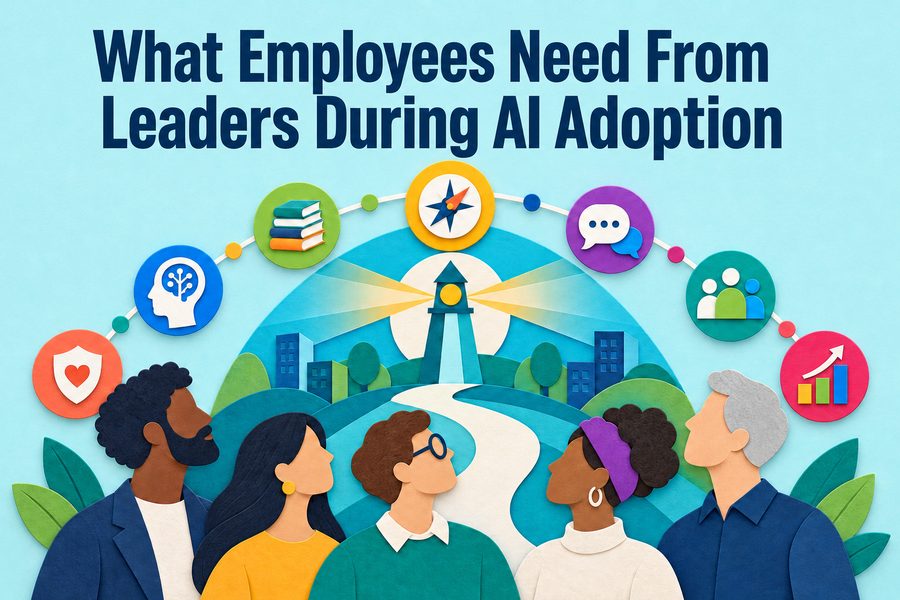
What Employees Need From Leaders During AI Adoption
About this resource
AI adoption is decided in the gap between the announcement and the following Tuesday morning. The announcement is leadership work. Tuesday morning belongs to whoever is standing in front of the team, and what happens there is determined almost entirely by whether people were given nine specific things. This guide names all nine: clarity, permission, safety to be bad at it, role relevance, time to learn, meaningful guardrails, feedback on the work, reinforcement, and visible leadership use.
Each one comes with what it sounds like when it is present and what happens when it is absent, because the absence never produces a complaint. It produces silence, which is why AI adoption problems are usually discovered two quarters after they began. The guide includes a behavior comparison table, three things worth saying out loud, and a ten-item leadership self-check scored on whether an employee could point to where they saw it rather than on whether you believe it. None of the nine require budget.
None of them require budget. Most require a decision and then the discipline to keep making it visible for longer than feels necessary.
How to use it
Take the ten-item self-check and mark only the items an employee could point to. The unmarked boxes are your work list, and they cost less than whatever is currently being proposed as the solution. This is management work rather than a training initiative, which is the whole argument: training can teach a skill, but it cannot give permission, protect time, define boundaries, review work product, or make the subject appear in a weekly conversation.
Inside the download
Why the most common reason careful employees do not use AI is that nobody said they could.
Why your most experienced staff opt out first, and what changes that.
Why one generic session teaches everyone a little and nobody enough.
Learning on personal time is only available to people who have personal time.
Common questions
Nine things: a specific reason this organization is doing it, explicit permission to use AI on real work, safety to be visibly unskilled at first, training built on their actual job, protected time to learn, clear guardrails given as guidance rather than warning, feedback on the work they produced, the subject appearing in ordinary weekly conversation, and leaders using the tools visibly including when it goes badly.
Most often because nobody told them it was expected rather than merely tolerated. In the absence of an explicit statement, people infer, and under uncertainty they infer conservatively. Access without permission produces private use, which cannot be improved, shared, governed, or measured.
A management problem with a training component. Training can teach a skill, but it cannot give permission, protect time against something urgent, define boundaries, review work product, or put the subject into the weekly conversation where work gets directed. Every one of those sits with a manager.
Free. No email list, no follow-up sequence.
More from the resource library, chosen because they pair well with this one.
Who builds it, who breaks it, and why nothing else works without it. A nine-role matrix covering everyone from the board to the next desk.
What to say when your team asks the hard questions. Six conversations, with the language that works and the language that backfires.
Warning signs that show up long before anyone calls it a problem, and the three clusters that tell you what kind of problem you have.
Tell us a little about yourself and this document is yours. We don't have an email list. We collect this so we know who's finding our resources useful, and that's it.
You're downloading
this document
Your information is kept confidential and never shared with anyone.