Leading People Through Change Whole-Organization Guide

Would Someone on Your Team Tell You They Made a Mistake With AI?

Psychological Safety During AI Adoption

Free PDF Updated The Jonesi Consultancy
Psychological Safety Team Culture Nine-Role Matrix For All Leaders
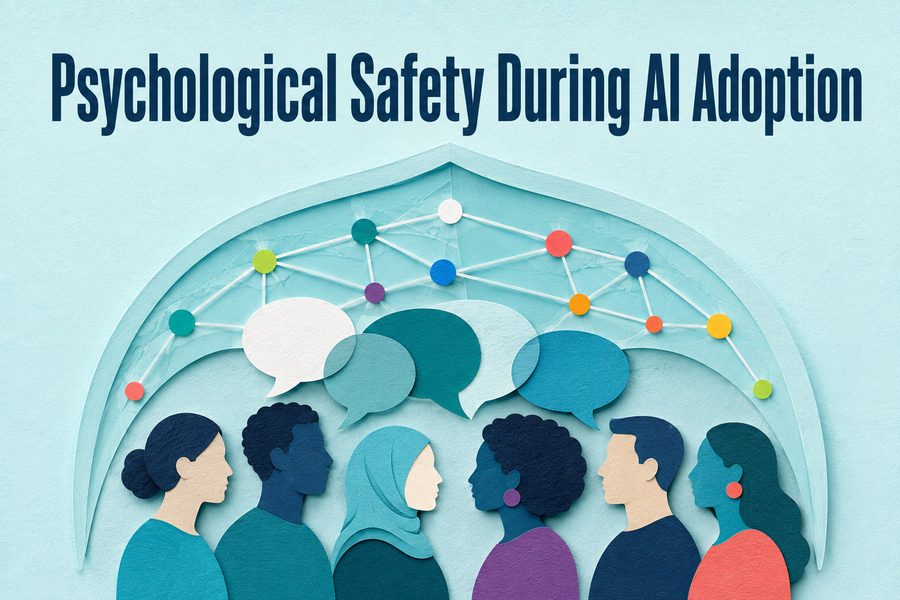
Psychological Safety During AI Adoption cover image
Download the Free PDF

Free. No email list, no follow-up sequence.

About this resource

What this guide covers

Every organization adopting AI is asking its people to be visibly bad at something in front of colleagues, to admit when they do not understand, and to report their own mistakes quickly. Those three behaviors are the entire mechanism of adoption, and all three are impossible where being wrong is expensive. This guide treats psychological safety as the variable that determines whether the technical work produces anything.

It defines the term and clears away four common misreadings, explains why it matters for learning, professional development, risk-taking, and recovery speed after a mistake, then sets out six building blocks and ten behaviors that destroy it. The centerpiece is a nine-role matrix showing what builds and breaks safety for executives, directors, frontline supervisors, teammates, colleagues on other teams, board members, IT and security, HR, and external partners. This is organizational leadership content rather than clinical content, though it is built by a licensed clinical social worker.

An executive can do everything correctly and still lead an unsafe organization, because the signal that decides how a person behaves usually comes from the colleague sitting next to them.

How to use it

Purpose, and how this will help

Read the nine-role matrix and find your own row, then read the row for the group you complain about most. Psychological safety is not created by announcing it. It is created by what happens the first time somebody tests it, and then by what happens the second time. People will run that test whether or not you are ready, usually at an inconvenient moment, and the result will be understood by the entire team before the end of the week.

Inside the download

What you'll take away

1

Get a working definition

What psychological safety is, and the four things people commonly mistake it for.

2

See why it is paramount

Its effect on learning, development, risk-taking, and recovery after falling short.

3

Build it deliberately

Six building blocks, starting with predictability, the strongest single predictor.

4

Stop destroying it

Ten behaviors, almost none malicious, most of them what a busy manager does by default.

Who this is for

  • Executives and boards setting the tone for an AI rollout
  • Directors and frontline supervisors who carry the daily signal
  • HR and people leaders responsible for the culture around change
  • Whole teams, since peers do more daily damage than any manager

Common questions

Frequently asked

What is psychological safety at work?

The shared belief that this is a place where you can say "I do not know," "I made a mistake," or "I think this is wrong" without it costing you standing, opportunity, or security. It is a property of a group rather than a person, which means it can be built and it can be lost, sometimes within a single meeting.

Why does psychological safety matter for AI adoption?

Because adoption requires three behaviors that are impossible where being wrong is expensive: being visibly unskilled in front of colleagues, admitting you do not understand something, and reporting your own mistakes quickly. Where safety is absent, people study privately and slowly, manage their image instead of building capability, and conceal errors until they become incidents.

What destroys psychological safety on a team?

Correcting somebody in front of the team, changing rules without announcing the change, turning skill level into a status marker through leaderboards or rankings, job-threat messaging including as a joke, mandating use you never demonstrate, describing monitoring as support, reacting to the person who reported rather than the situation, and silence after something goes wrong.

Download the Free PDF

Free. No email list, no follow-up sequence.

Keep Reading

Related Resources

More from the resource library, chosen because they pair well with this one.