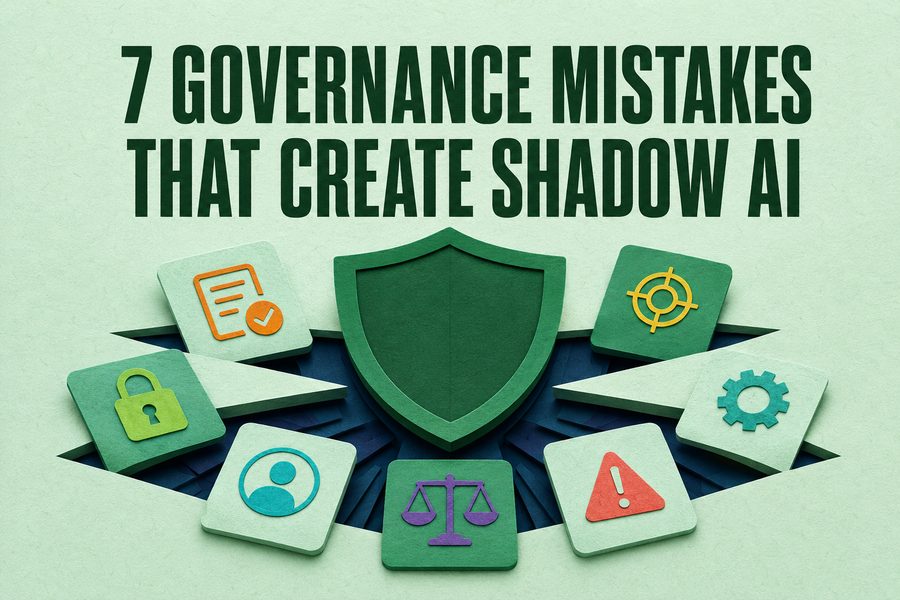
7 Governance Mistakes That Create Shadow AI
About this resource
Almost every organization has shadow AI: employees using unapproved tools for work, usually on personal accounts, usually without telling anyone. The instinctive response is a stricter policy and a reminder of it. That response reliably makes the problem worse, because it addresses the behavior rather than the reason for it. Shadow AI is a signal that somewhere between what people need to do their job and what the organization has sanctioned, there is a gap.
This guide names the seven most common ways that gap gets created, every one of them by people acting responsibly: rules too restrictive to comply with, no approved tool list, approval that takes longer than the need, no safe path for experimentation, rules written without the people who do the work, leadership behaving differently from staff, and no safe way to report a mistake already made. Each carries what to do instead. It closes with seven observable indicators and the amnesty conversation, which works exactly once and only if it holds.
Prohibition does not remove the exposure. It removes your knowledge of it. An employee on a personal account puts your information somewhere you have no agreement, no retention terms, and no audit trail.
How to use it
Read it before you tighten anything. The test worth applying to any rule you are about to write is whether an employee under deadline pressure can follow it and still do their job. If the answer is no, you have not written a control; you have written the reason your next incident is discovered late. Start by publishing an approved list this week, because that single act closes the largest gap on the page.
Inside the download
Why the most restrictive policies produce the highest rates of unsanctioned use.
Publishing an approved list, however short, removes most of the problem in a week.
Why an eight-week review is functionally a prohibition, and everyone learns that in one cycle.
A bounded space for experimentation so curiosity does not move to a personal account.
Common questions
Shadow AI is employees using unapproved AI tools for work, typically on personal accounts and typically without telling anyone. It puts organizational information somewhere with no agreement, no retention terms, no audit trail, and no route to respond if something goes wrong. The organization carries the full exposure with none of the visibility.
Make the sanctioned path better than the workaround. Publish an approved list, set and hold a response time for new tool requests, define a low-stakes lane where experimentation is explicitly permitted, and write good-faith reporting protection into the policy. Prohibition alone moves usage out of view rather than stopping it.
Watch for indicators rather than asking directly, since a survey asks people to report a policy violation. Output quality varying in ways that do not track with skill, work produced faster than the sanctioned tooling explains, nobody requesting a new tool in six months, an approved list that has never changed, and nobody reporting a mistake in a year are all signals.
Free. No email list, no follow-up sequence.
More from the resource library, chosen because they pair well with this one.
Seven groups, seven different responsibilities, and the assumption that everybody else owns AI.
Eight questions to answer before you write an AI use policy, plus the governance stack and the policy test.
Who builds it, who breaks it, and why nothing else works without it. A nine-role matrix covering everyone from the board to the next desk.
Tell us a little about yourself and this document is yours. We don't have an email list. We collect this so we know who's finding our resources useful, and that's it.
You're downloading
this document
Your information is kept confidential and never shared with anyone.