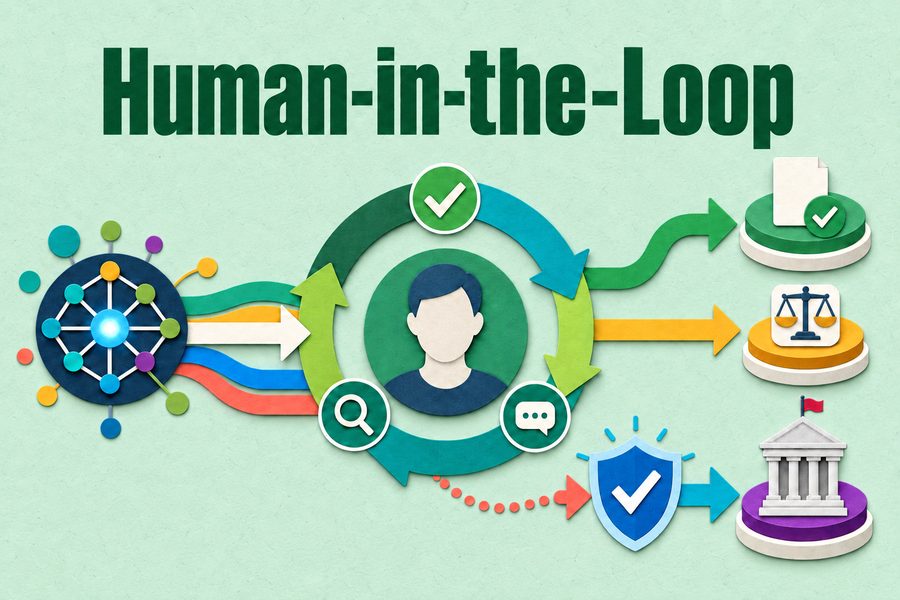
Human-in-the-Loop
About this resource
Every organization using AI eventually reaches the same question: how much checking is enough? Check everything and the efficiency disappears. Check nothing and you are one confident-sounding error away from a conversation you do not want to have. The answer is not a percentage. It is a judgment about stakes, made in advance, so nobody has to make it under time pressure on a Friday afternoon.
This guide gives you a way to make that judgment consistently. It sets out three levels of stakes with what human review specifically means at each, four questions to ask before acting on any output, and worked examples across finance, legal, HR, healthcare, client-facing work, operations, and public communications. It then covers where to place checkpoints, what to document, when to disclose, and the four conditions that should trigger escalation rather than a decision, including the one that matters most: being asked to approve work you are not qualified to evaluate.
Deciding which level a piece of work sits in is the whole exercise. Once that is settled, what to do is obvious. Organizations that struggle have skipped the classification and gone straight to arguing about how careful to be.
How to use it
Classify one category of your work before you need to. The pressure to approve something you cannot properly assess is the characteristic failure mode of AI in organizations, because the output looks finished and competent regardless of whether it is either. Deciding the level in advance means nobody has to make that call while a deadline is running, which is the only time it actually gets made badly.
Inside the download
Three levels, so review effort scales with consequence instead of being uniform.
Level 3 requires a qualified human doing the substantive work, not a person clicking approve.
What is at stake, who is affected, what could be fabricated, and who is accountable.
Where the line falls in finance, legal, HR, clinical, client work, operations, and public statements.
Common questions
It means a required point where a person reviews and approves before AI output is used or released, with the effort scaled to the stakes. At low stakes it means reading the output and noticing if something looks wrong. At high stakes it means a qualified human doing the substantive work while AI assists at the margins, a second reviewer signing, and the AI contribution documented.
Always, with the depth determined by consequence. Work that stays inside your own head needs a quick read. Work that leaves your hands or informs somebody else’s decision needs every factual claim, figure, name, date, and citation verified. Work affecting money, employment, health, legal position, safety, or rights requires a qualified person and a second reviewer.
The person who sent the work. No regulator, client, board, or court has accepted a tool as the responsible party, and none is likely to. This is worth stating plainly inside an organization, because in the absence of a statement people develop private theories, and the most common one is that responsibility is shared, which in practice means nobody feels like the last line.
Free. No email list, no follow-up sequence.
More from the resource library, chosen because they pair well with this one.
A one-page data rule for everyone who uses these tools. Print it and put it where people can see it.
A five-step human-in-the-loop verification discipline you can run on any AI response in under sixty seconds.
Why fabrication happens, where it concentrates, and a detection routine scaled to the stakes.
Tell us a little about yourself and this document is yours. We don't have an email list. We collect this so we know who's finding our resources useful, and that's it.
You're downloading
this document
Your information is kept confidential and never shared with anyone.