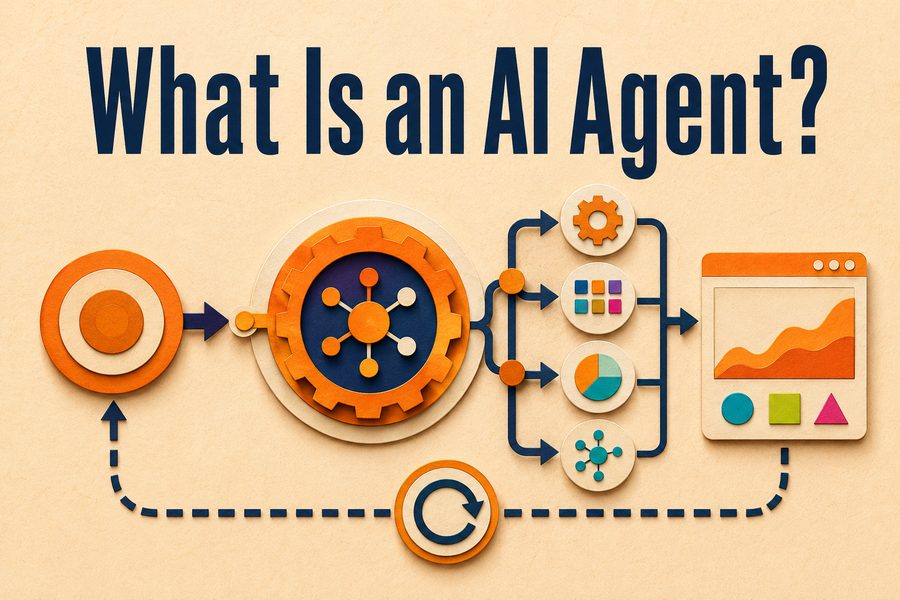
What Is an AI Agent?
About this resource
"Agent" has become the most used and least defined word in the current AI conversation. Vendors apply it to everything from a chatbot with a menu to software that books travel and moves money. The distinction matters because it changes the question you should be asking, from what the tool can do to who answers for what it did. This one-page explainer defines AI agents plainly.
It covers the actual difference between an assistant that advises and an agent that acts, the three things that have to be present before something is genuinely agentic, what they are currently good and bad at, and the specific questions to ask a vendor selling one. It is written for people who will be asked to approve one, not for people building one.
The whole distinction is in one word. An assistant produces something you then act on. An agent takes the action itself, which moves the accountability question ahead of the capability question.
How to use it
Read it before the vendor call rather than after. The word is doing heavy lifting in sales conversations right now, and the useful move is to ask what specifically the software does without a human in between, and what happens when it does that wrongly. Those two questions resolve most of the ambiguity in about a minute.
Inside the download
What has to be true before something is genuinely an agent rather than a chatbot with steps.
Why software that acts changes the governance question before it changes the capability one.
What agents handle reliably today and where they still fail in ways that matter.
Specific questions to ask when a vendor uses the word.
Common questions
An AI agent is software that takes actions toward a goal rather than only producing output for a person to act on. It can typically use tools, work through several steps, and react to what it finds along the way. The defining feature is that it does something in the world rather than handing you a draft.
A chatbot responds. An agent acts. When you ask a chatbot to reschedule a meeting it writes the email for you to send; an agent sends it. That difference relocates the accountability question, because a person who never saw the output is still responsible for it.
They can be, within bounded scopes where the actions are reversible, the permissions are narrow, and a human reviews anything consequential. The risk is not that an agent goes rogue. It is that it does exactly what it was told, quickly and at scale, before anyone notices the instruction was wrong.
Free. No email list, no follow-up sequence.
More from the resource library, chosen because they pair well with this one.
Six controls for software that acts rather than advises, including the one most people never test.
Scope an agent before it is built, including the non-goals section teams skip and later regret.
Ten questions for directors approving something they cannot evaluate, with what a good answer sounds like and what should concern you.
Tell us a little about yourself and this document is yours. We don't have an email list. We collect this so we know who's finding our resources useful, and that's it.
You're downloading
this document
Your information is kept confidential and never shared with anyone.