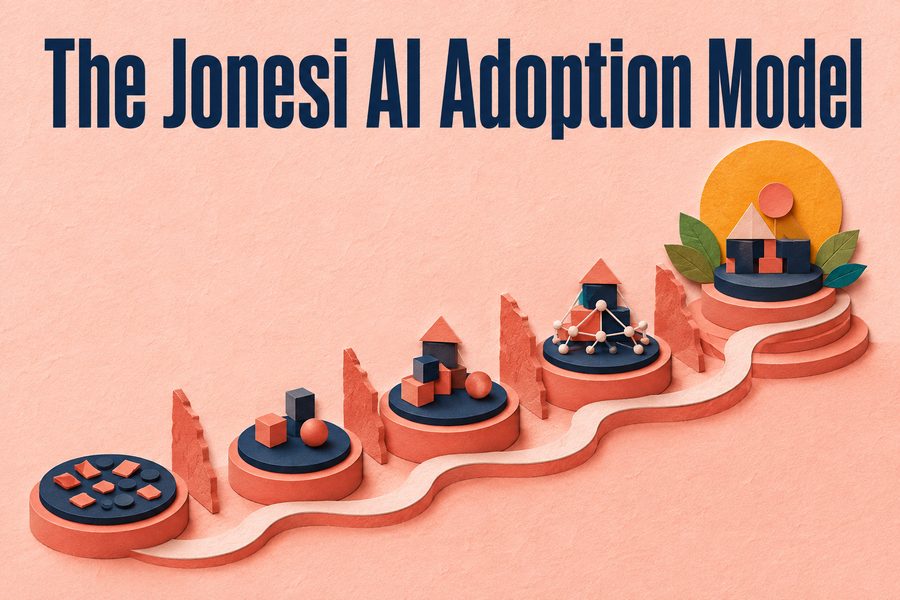
The Jonesi AI Adoption Model
About this resource
Most AI adoption failures are not technology failures. They are sequencing failures. An organization buys capable tools, runs competent training, and finds a year later that very little about the work has changed, because a stage was skipped and nobody noticed until the consequence arrived. The Jonesi AI Adoption Model maps the five stages every organization moves through, in the order they have to happen: Awareness, Confidence, Capability, Integration, and Optimization.
Each stage gets its own page covering the focus, the barrier that defines it, what leadership specifically has to do, and what the stage looks like when it is working. The guide closes with the five shortcuts organizations reliably take and the predictable failure each one produces, from shelfware to shadow AI to a program that is genuinely working and cannot be defended. This is the map of the terrain, not the instrument we use to place an organization on it.
Sequential by design. Organizations that skip a stage do not move faster, they pay for it later at a higher price, and the bill usually arrives about eight months after the shortcut.
How to use it
Read the stage descriptions and place your organization honestly, including the stage you would prefer to skip. Almost every organization wants to start at Integration, because that is where the measurable value sits. The model exists to explain why starting there produces individual productivity that never becomes organizational capability, and what it costs to go back and build the earlier stages afterward.
Inside the download
A single table with focus, barrier, leadership action, and outcome for each stage.
Each stage includes what it looks like when it is actually working, so you can place yourself.
Why the value only appears when the last stage is in place, not before.
Skip Awareness and you get shelfware. Skip Confidence and you get shadow AI. Each one is named.
Common questions
The Jonesi AI Adoption Model describes five sequential stages. Awareness establishes a shared and realistic understanding. Confidence builds the psychological safety required for people to try. Capability converts curiosity into repeatable skill. Integration redesigns the work itself so individual skill becomes organizational capability. Optimization measures the result and sustains it through governance.
Most often because a stage was skipped rather than because the technology underperformed. Skipping Awareness produces tools nobody uses. Skipping Confidence pushes usage onto personal accounts. Skipping Capability leaves staff aware of AI and unable to apply it. Skipping Integration produces individual speed that never scales. Skipping Optimization leaves a working program with no evidence to defend it.
It can, and the failure is predictable rather than random. Each stage builds the foundation for the next, so a shortcut does not accelerate the timeline. It defers the cost and raises it, and the consequence is usually discovered two quarters after the decision that caused it.
Free. No email list, no follow-up sequence.
More from the resource library, chosen because they pair well with this one.
Why an organization can be full of people using AI and still have no organizational capability to show for it.
Ten statements, one score, four result bands. A five-minute self-assessment that tells a leadership team where the organization actually stands with AI.
Who builds it, who breaks it, and why nothing else works without it. A nine-role matrix covering everyone from the board to the next desk.
Tell us a little about yourself and this document is yours. We don't have an email list. We collect this so we know who's finding our resources useful, and that's it.
You're downloading
this document
Your information is kept confidential and never shared with anyone.