Start Here: Where You Stand Leader's Field Guide

Your Team Uses AI Every Day. So Why Can’t You Point to Anything That Changed?

AI Use vs. AI Integration

Free PDF Updated The Jonesi Consultancy
AI Integration Workflow Redesign For Executives AI Strategy
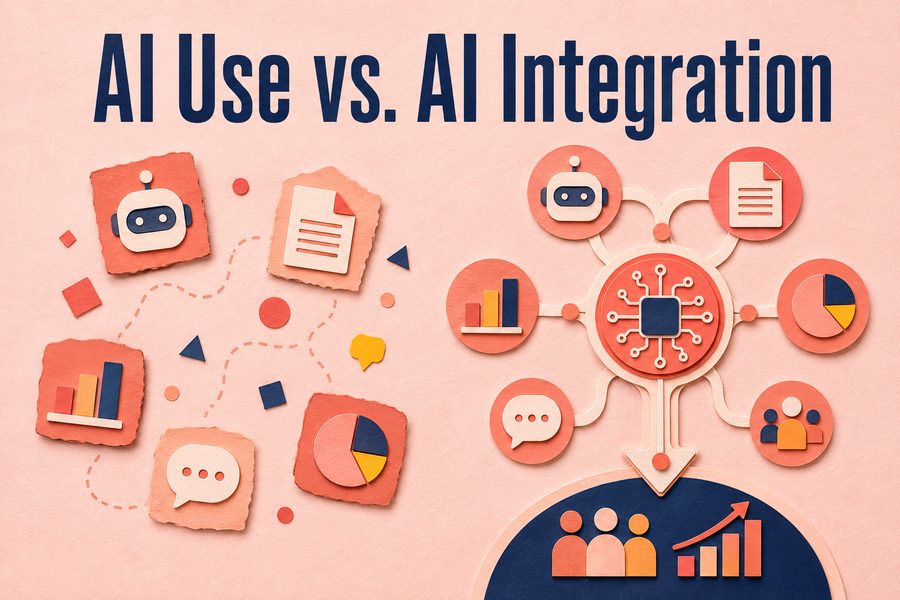
AI Use vs. AI Integration cover image
Download the Free PDF

Free. No email list, no follow-up sequence.

About this resource

What this guide covers

An organization can be full of people using AI and still have nothing to show for it. That is not a contradiction, it is the most common outcome, and it happens because AI use and AI integration are different things that share a vocabulary. Use is what an individual does with a tool. Integration is what happens when the work itself has been redesigned around where the tool actually helps.

This field guide separates the two. It sets out four levels of what gets called "using AI," from private experimentation through to embedded workflow, with a side-by-side comparison of what each level produces. It then names six symptoms of use without integration, works through three concrete examples, and closes with the four investments that convert one into the other. It is written for the leader who has bought the licenses, seen the enthusiasm, and cannot find the change in any number they report.

Only the fourth produces something measurable. The first three feel like progress, get reported as progress, and leave the organization exactly where it was when the person who developed the habit leaves.

How to use it

Purpose, and how this will help

Read the four levels and place one specific workflow, not the whole organization. Most teams sit at level two or three and assume they are at four, because level three feels productive and is reported as progress. The guide exists to make that distinction visible while there is still time to redesign a process rather than defend a renewal.

Inside the download

What you'll take away

1

Separate two things

A working distinction between what an individual does and what the organization has.

2

Place your organization

Four levels with what each one produces, so you can identify where you actually are.

3

Recognize the symptoms

Six signs that your AI activity is not accumulating into anything.

4

See it in three examples

Concrete before-and-after workflows rather than abstract principle.

Who this is for

  • Executives who cannot find AI results in the numbers they report
  • Operations and process owners responsible for how work gets done
  • Transformation and continuous improvement leads
  • Finance leaders being asked to justify a renewal

Common questions

Frequently asked

What is the difference between AI use and AI integration?

AI use is an individual applying a tool to their own tasks, which produces personal productivity that leaves when the person does. AI integration is the work itself redesigned around where AI helps, with written procedures, defined review points, and shared practice, which produces organizational capability that survives turnover.

Why does AI use not translate into business results?

Because individual speed does not aggregate automatically. Without a redesigned workflow, the time saved is absorbed into a busier day, the practice is never written down, and nothing in any system records that the process changed. The gain is real for the person and invisible in the financial statements.

How do you move from AI use to AI integration?

Pick one workflow, capture what it costs today, decide where AI helps and where a human decides, write the procedure down, and add it to onboarding so a new hire learns the current way rather than the old one. Doing this once produces more measurable change than broad enthusiasm across a whole department.

Download the Free PDF

Free. No email list, no follow-up sequence.

Keep Reading

Related Resources

More from the resource library, chosen because they pair well with this one.