You Wrote the AI Policy. Why Has Nothing About the Work Changed?

AI Policy Is Not AI Adoption

Free PDF Updated The Jonesi Consultancy
AI Governance AI Adoption For Executives Diagnostic
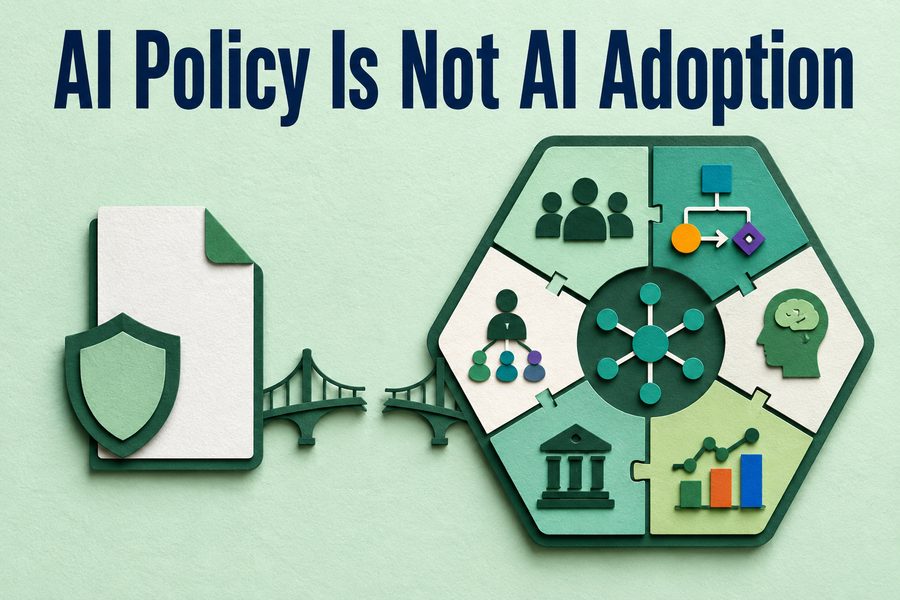
AI Policy Is Not AI Adoption cover image
Download the Free PDF

Free. No email list, no follow-up sequence.

About this resource

What this guide covers

A great many organizations have handled AI. They convened a group, drafted a document, circulated it for acknowledgment, and moved the item off the agenda. The policy is genuinely good. And in a meaningful number of those organizations, almost nothing about how work gets done has changed. This guide explains why that is not a failure of the policy but a category error about what a policy is for.

It separates the six layers that get treated as one thing: policy, governance, training, capability, workflow integration, and measurement. It sets out plainly what an AI policy can accomplish and what it structurally cannot, then names five failure patterns that appear in roughly the order organizations produce them, from policy without training through to everything except measurement. It closes with six questions that test whether your policy connects to practice at all.

Boundaries plus capability plus reinforcement plus measurement equals sustainable adoption. Remove any one term and the result is not a smaller version of adoption. It is a different outcome, usually a worse one, because the money has been spent.

How to use it

Purpose, and how this will help

Read it if your organization has a policy and cannot point to a changed process. The document is the cheapest part of governance and the part most likely to be mistaken for the whole. Use the six tests as a short agenda item: if three or more come back wrong, the next investment is capability rather than more policy language, and that is a considerably different conversation with your CFO.

Inside the download

What you'll take away

1

Separate the six layers

Policy, governance, training, capability, workflow, and measurement, and what each one actually delivers.

2

Know the honest limits

What a policy can establish, and the seven things it structurally cannot do.

3

Recognize your pattern

Five failure modes in the order organizations produce them.

4

Understand shadow AI risk

Why a policy that is too restrictive makes the organization less safe than having none.

Who this is for

  • Executives who signed off on an AI policy and are waiting for results
  • Legal, risk, and compliance leaders asked what happens next
  • HR and operations leaders holding the implementation
  • Boards reviewing whether management has finished the work

Common questions

Frequently asked

Is an AI use policy enough to manage AI risk?

No. A policy establishes boundaries and creates a defensible position, but it cannot teach anyone to write a useful prompt or recognize a bad answer, change how a process is performed, protect the time it takes to become competent, produce a baseline or a measurement, or overcome the belief that using AI marks someone as replaceable. Each of those requires a separate investment.

What comes after writing an AI policy?

Capability and workflow. A policy answers what is allowed; it does not produce skill or change how work is done. The next steps are role-specific training on actual tasks, redesigning one workflow and writing the procedure down, and capturing a baseline so the result can be measured.

Why do good AI policies fail to change behavior?

Because policy and capability are usually owned by different people and only the first gets funded. Permission arrives as a document from leadership and legal, while competence arrives slowly through training, management practice, and redesigned work. An organization with permission and no competence has staff who are allowed to do something they cannot do well.

Download the Free PDF

Free. No email list, no follow-up sequence.

Keep Reading

Related Resources

More from the resource library, chosen because they pair well with this one.