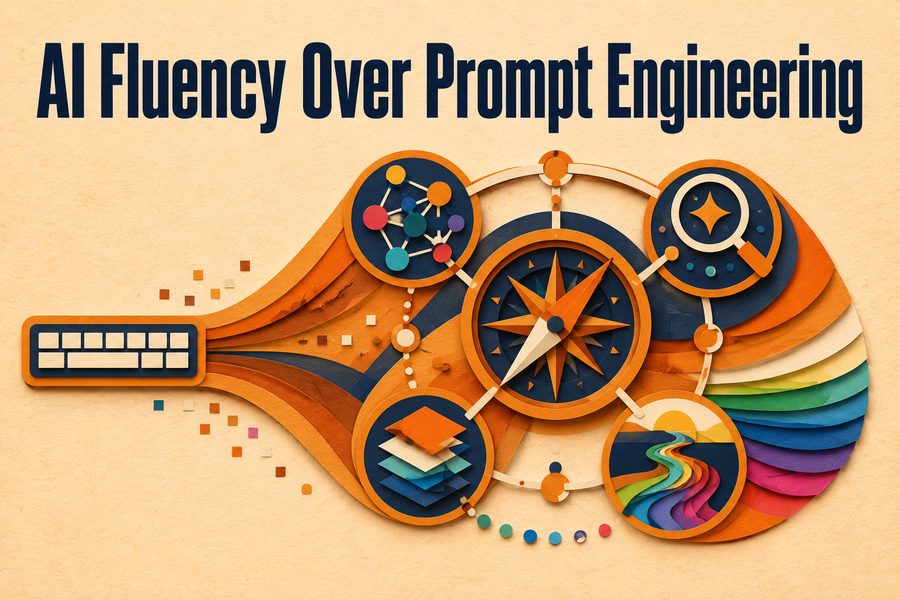
AI Fluency Over Prompt Engineering
About this resource
Prompt engineering is a real skill and a poor foundation for an organization. Technique is tied to the model generation it was learned on, and every release quietly invalidates a portion of it. Judgment about when to use these tools, what they are bad at, and what has to be checked does not expire. This one-page guide sets out the case for AI fluency over technique, side by side, in a format you can put in front of a leadership team.
It is the clearest single statement of how we think about capability building. Organizations that invest exclusively in prompt technique end up retraining with every model release, because the thing they taught was the part that changed. Organizations that invest in fluency, meaning the ability to judge where AI belongs in a piece of work and to recognize when an answer is wrong, keep the value and add technique on top of it. Worth reading before you commission a training program built around a tool rather than around the work.
Technique changes with every model generation. Judgment about when to use these tools, and what they are bad at, does not. That distinction decides whether training becomes an asset or an expense.
How to use it
Read it before you approve a training budget. The distinction it draws changes what you buy: a program built around a specific tool teaches something that will need replacing, while a program built around judgment produces capability that survives the next release and the one after it. Technique still matters and it is cheap to add later. Judgment is the expensive part and it has to come first.
Inside the download
What survives a model release and what quietly stops working.
Why a curriculum built on prompt tricks has a shelf life measured in months.
A basis for asking whether a program teaches the tool or the work.
Fluency moves with a person between tools, roles, and vendors.
Common questions
AI fluency is the ability to judge where AI belongs in a piece of work, what these tools are reliably bad at, and when an answer needs to be checked or discarded. It is distinct from prompt engineering, which is the technique of phrasing requests. Fluency transfers between tools and survives model releases; technique frequently does not.
Yes, as a layer rather than a foundation. Prompt technique produces measurably better results and it is cheap to teach. The problem is building an entire capability program on it, because techniques are tied to the model generation they were learned on and each release invalidates some of them.
Start with judgment: which tasks are appropriate for AI assistance, what information must never be entered, and how to verify output proportionate to the stakes. Add technique after that, using examples from the work the person actually does each week. Training built around a tool rather than around the work produces enthusiasm that fades within about a month.
Free. No email list, no follow-up sequence.
More from the resource library, chosen because they pair well with this one.
Plain definitions and why each term matters to somebody running an organization, plus five vendor phrases worth pushing back on.
A curated guide to external courses, prompt libraries, and role guides, each with a note on who it actually suits.
Nine things that decide whether any of this takes hold, and a ten-item leadership self-check scored on evidence rather than intent.
Tell us a little about yourself and this document is yours. We don't have an email list. We collect this so we know who's finding our resources useful, and that's it.
You're downloading
this document
Your information is kept confidential and never shared with anyone.