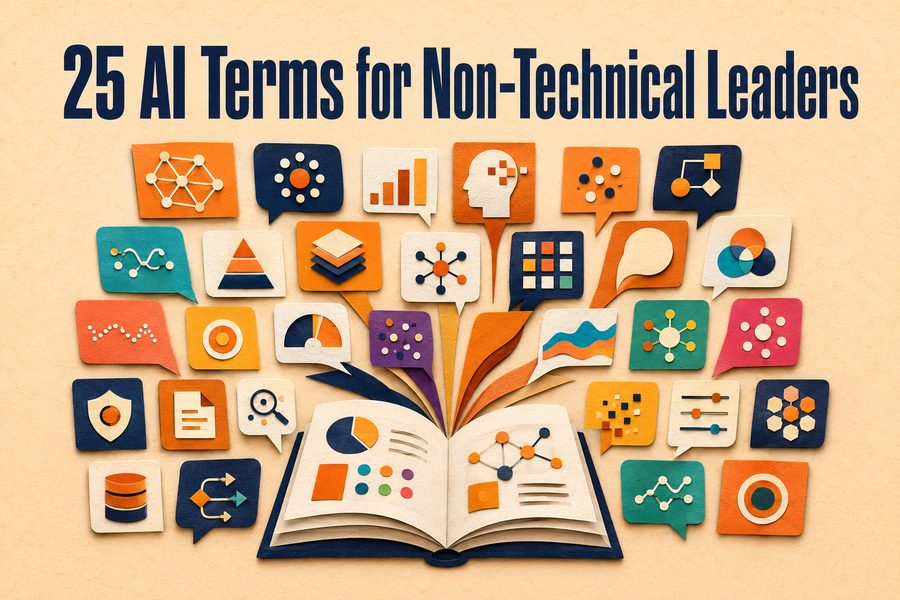
25 AI Terms for Non-Technical Leaders
About this resource
Nobody leading an organization needs to understand how these systems are built. What is useful is knowing what the words mean when they appear in a vendor proposal, an IT recommendation, or a board paper, because that is where the vocabulary is doing work. This free AI glossary covers twenty-five terms in four groups: foundations, how these systems behave, working with them, and risk and governance.
Every entry gives a plain definition and then a second line on why it matters to you specifically, which is the reason the entry is there. Knowledge cutoff explains why a confident answer about current conditions may be describing a world that has moved on. Hallucination explains why verification is permanent rather than temporary. Retrieval augmented generation is the phrase most likely to appear in a proposal you are asked to approve. The guide closes with five vendor phrases that sound more precise than they are, and the specific question to ask instead of accepting each one.
Grouped into four families, each with a plain definition and a line on why it matters to a decision-maker. Plus five vendor phrases and the question to ask instead of accepting them.
How to use it
Read the three terms that carry the most weight first: hallucination, knowledge cutoff, and human-in-the-loop. Between them they explain why verification is permanent, why a confident answer can still be out of date, and what the only control that reliably catches both actually is. Keep the vendor phrases page in front of you during a demo. Most poor AI decisions are made not because leadership did not understand the technology, but because nobody in the room felt equipped to ask what a particular sentence meant.
Inside the download
Know what "AI-powered," "it learns from your data," and "enterprise-grade security" actually commit a vendor to.
Why hallucination is a property of how these systems work rather than a defect awaiting a patch.
What a knowledge cutoff is, and why it matters before you trust an answer about current conditions.
Two very different proposals with very different price tags, and which one usually solves the problem.
Common questions
Three carry the most weight. Hallucination explains why AI produces fabricated information with full confidence, which is why human verification is permanent rather than temporary. Knowledge cutoff explains why a model has no built-in information after a certain date. Human-in-the-loop is the control that addresses both. Beyond those, retrieval augmented generation and fine-tuning are worth knowing because they appear in vendor proposals with very different costs.
A hallucination is when a model produces information that is fabricated but presented with the same confidence as anything else it says. It is a property of how these systems work rather than a defect awaiting a fix, which is why a person has to verify factual claims, figures, citations, names, and dates before the output is used.
Retrieval augmented generation connects a model to your own documents so it answers from them rather than from memory. Fine-tuning is additional training on your material to change how the model behaves. Retrieval is usually faster, cheaper, and easier to update, and it solves the problem more often than vendors suggest, so it is worth asking whether retrieval would work before agreeing to fine-tune.
Free. No email list, no follow-up sequence.
More from the resource library, chosen because they pair well with this one.
Sustainable AI success starts with how people think, not just what they type. A side-by-side case for fluency over technique.
Ten statements, one score, four result bands. A five-minute self-assessment that tells a leadership team where the organization actually stands with AI.
Ten questions for directors approving something they cannot evaluate, with what a good answer sounds like and what should concern you.
Tell us a little about yourself and this document is yours. We don't have an email list. We collect this so we know who's finding our resources useful, and that's it.
You're downloading
this document
Your information is kept confidential and never shared with anyone.