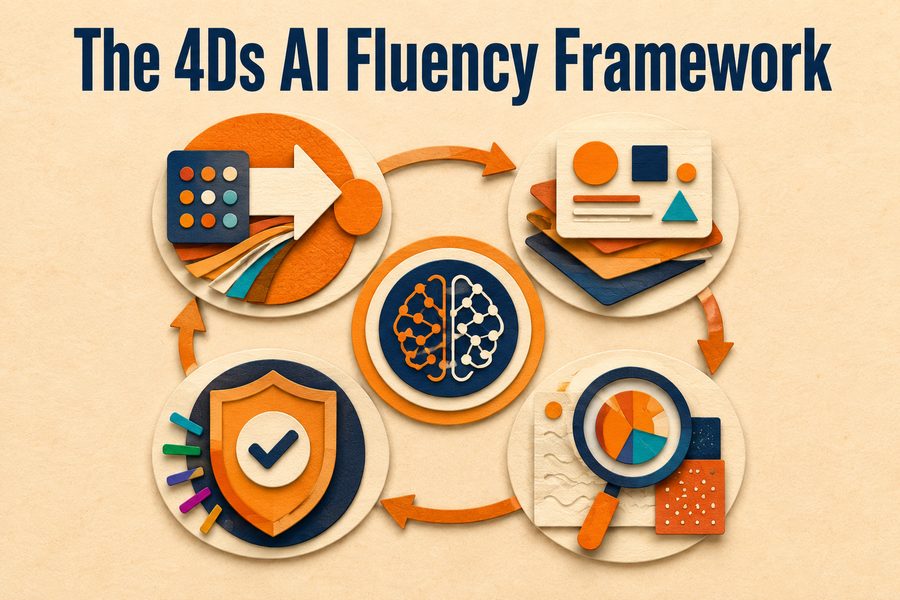
The 4Ds AI Fluency Framework
About this resource
Fluency with AI is not a single skill. It is four, and most training addresses only one of them. The 4Ds framework names all four: Delegation, deciding what should go to AI and what should not; Description, communicating what you actually want; Discernment, evaluating what comes back; and Diligence, taking responsibility for how it is used.
The framework is not ours. It was developed by Anthropic in collaboration with Ringling College of Art and Design and Vanderbilt University, and is shared under a Creative Commons Attribution-NonCommercial-ShareAlike 4.0 licence. We teach it because it is the clearest available articulation of why prompting technique alone produces disappointing results: technique is Description, and it is one skill out of four.
Attribution and licence
The 4Ds AI Fluency Framework was developed by Anthropic in collaboration with Ringling College of Art and Design and Vanderbilt University, and is licensed under Creative Commons Attribution-NonCommercial-ShareAlike 4.0 International. The Jonesi Consultancy teaches this framework with attribution. It is not TJC intellectual property and it is not the basis of any paid TJC offering.
Most AI training teaches Description and stops. That is one of four, which is why so many trained teams still produce poor results.
How to use it
Use it to audit a training proposal. If a programme addresses Description and nothing else, it will produce a visible improvement that fades within about a month, because the other three skills determine whether anything survives contact with real work. The framework is freely available, so any vendor charging for it as proprietary content is worth a second look.
Inside the download
Deciding what belongs with AI and what belongs with a person, which precedes every other skill.
Communicating intent clearly, which is what most people mean by prompting.
Evaluating output critically rather than accepting fluency as correctness.
Taking responsibility for how AI-assisted work is used and disclosed.
Common questions
A model naming four distinct skills required to work well with AI: Delegation, deciding what to assign to AI; Description, communicating what you want; Discernment, evaluating the result; and Diligence, taking responsibility for its use. It was developed by Anthropic with Ringling College of Art and Design and Vanderbilt University.
Anthropic, in collaboration with Ringling College of Art and Design and Vanderbilt University. It is shared under a Creative Commons Attribution-NonCommercial-ShareAlike 4.0 licence, which means it can be taught and adapted with attribution but not sold as proprietary material.
Because prompting is one of the four skills. Knowing how to phrase a request does not tell you whether the task should have gone to AI at all, whether the answer is correct, or what your obligations are in using it. Training that covers only technique produces improvement that decays with the next model release.
Free. No email list, no follow-up sequence.
More from the resource library, chosen because they pair well with this one.
Sustainable AI success starts with how people think, not just what they type. A side-by-side case for fluency over technique.
A five-step human-in-the-loop verification discipline you can run on any AI response in under sixty seconds.
Nine things that decide whether any of this takes hold, and a ten-item leadership self-check scored on evidence rather than intent.
Tell us a little about yourself and this document is yours. We don't have an email list. We collect this so we know who's finding our resources useful, and that's it.
You're downloading
this document
Your information is kept confidential and never shared with anyone.