For Mission-Driven Organizations Nonprofit Starting Points

Do You Have to Solve Your Data Governance Before You Can Start at All?

Where AI Can Help a Nonprofit Without Touching Sensitive Client Data

Free PDF Updated The Jonesi Consultancy
For Nonprofits Client Data Privacy Safe Starting Points Free Guide
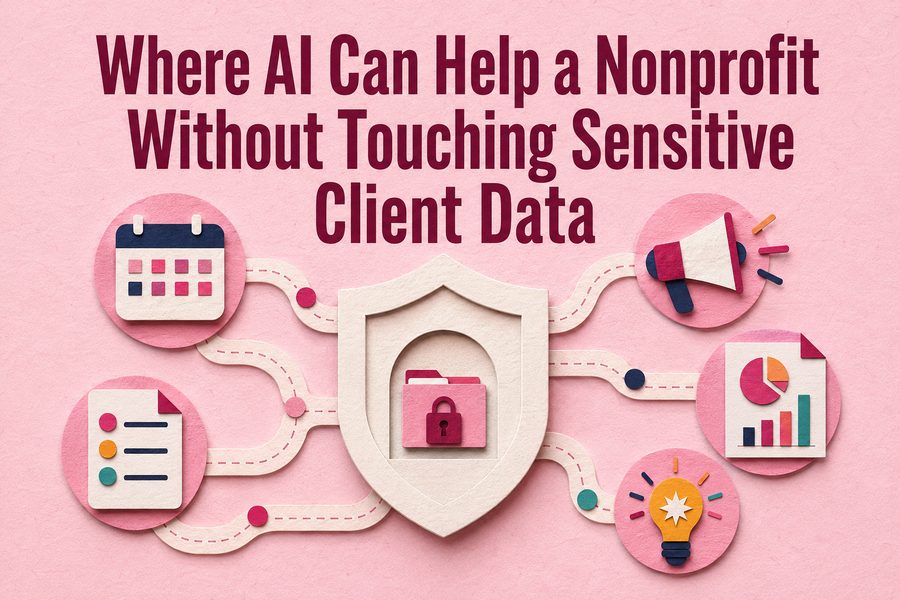
Where AI Can Help a Nonprofit Without Touching Sensitive Client Data cover image
Download the Free PDF

Free. No email list, no follow-up sequence.

About this resource

What this guide covers

Nonprofits are right to be cautious. You hold information about people in difficult circumstances, frequently under a legal obligation and always under a moral one. The mistake is concluding that caution means waiting. A large share of the work in any mission-driven organization involves no client information at all, and that work is where the capacity you are short of actually lives.

This free guide names eighteen places to start, grouped into fundraising and communications, program and operations, and administration and governance. Each entry includes the reason it sits safely outside the line. It states the line once, plainly, covering what never goes in regardless of tool or account type. It adds four places not to start, four techniques for the work that genuinely touches client information, three criteria for choosing a first task, and a closing section on deciding where the freed capacity goes before you free it.

Every one of them is work your organization already does, done from information your organization already owns and could publish. That is the test.

How to use it

Purpose, and how this will help

Pick one task, not a category. The right first task happens often, costs little when it goes wrong, and belongs to somebody who already wants to try, which is the criterion organizations skip. Then decide in advance where the freed capacity goes: a grant application you would otherwise have skipped, a stewardship call that was not happening, an hour a case worker spends with a person instead of a form. Capacity that has not been assigned somewhere reliably disappears.

Inside the download

What you'll take away

1

Start on fundraising

Appeal drafts, grant narratives, donor stewardship templates, and plain-language rewrites of your own material.

2

Use it on program work

Volunteer curricula, logic models, funder guideline summaries, and standard operating procedures.

3

Cover administration

Board materials, job descriptions, financial explanations for non-financial trustees, and annual report outlines.

4

Know the four exclusions

Case notes, anything tied to a named participant, employment decisions, and anything you must attest to.

Who this is for

  • Nonprofit executive directors and chief executives
  • Development and communications staff writing appeals and grants
  • Program directors and case-work supervisors
  • Operations and finance staff at mission-driven organizations

Common questions

Frequently asked

How can nonprofits use AI without risking client data?

Start with the substantial share of work that involves no client information: fundraising appeals and grant narratives, volunteer training curricula, logic models, summaries of published research and funder guidelines, standard operating procedures, board materials, and job descriptions. The test is whether the input could appear in your annual report without anyone objecting.

What should nonprofits never put into AI tools?

Case notes and service records, anything tied to a named participant including referral emails and benefit applications, health information, immigration status, and anything a participant told you in confidence. This holds regardless of the tool or the account type. Hiring, discipline, and performance decisions are also excluded.

Can AI help with grant writing for nonprofits?

Yes, and it is one of the safest starting points. Programs, methods, staffing, and need are organizational information rather than client information, as are the aggregate outcome figures you already publish. Drafting a narrative from your own program description involves no participant data at all.

Download the Free PDF

Free. No email list, no follow-up sequence.

Keep Reading

Related Resources

More from the resource library, chosen because they pair well with this one.