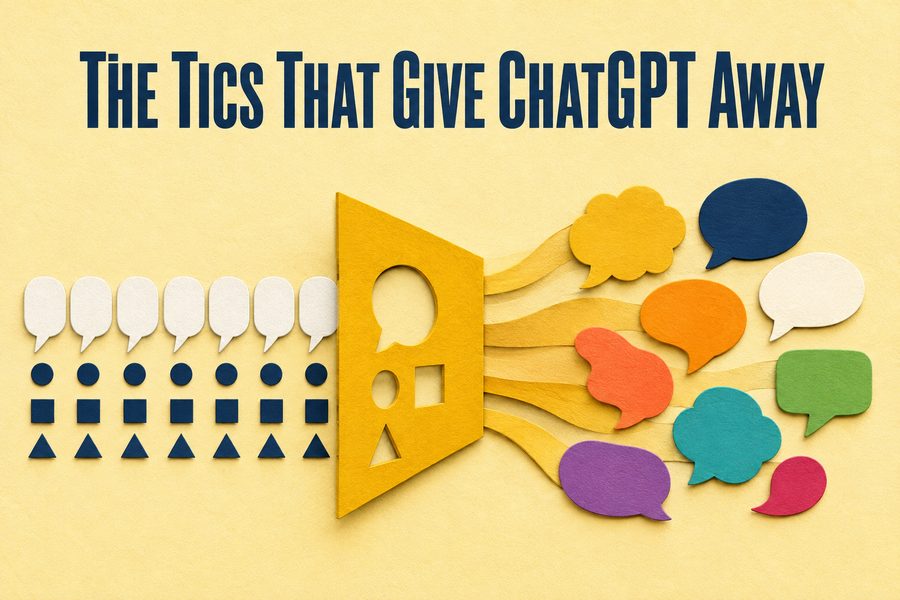
The Tics That Give ChatGPT Away
About this resource
Readers who spot AI writing rarely point at the reasoning. They point at the phrasing. Seven habits account for most of it, and none of them are errors; they are style artifacts of training that rewarded thorough, professional-sounding answers. This free one-page handout names all seven and gives you the exact instruction that switches each one off.
It covers the "Certainly!" preamble, the trailing offer to do more work, triplet adjectives, the triple-parallel paragraph closing, the reflex toward headers and bullet lists where prose would persuade better, heavy em dash use, and the hedging preamble that precedes something the model could have simply said. The page closes with a single copy-and-paste prompt that handles all seven at once, formatted so you can paste it into a conversation or save it once in your assistant’s custom instructions and stop thinking about it.
All seven come from training that rewarded thorough, professional-sounding answers. None of them are mistakes, which is exactly why the model will keep producing them until you say otherwise.
How to use it
Save the consolidated prompt in your assistant’s custom instructions and it applies to every conversation from then on. That is the version that actually changes your output, because a per-conversation instruction gets forgotten exactly when you are busy. Worth pairing with a verification habit: none of these corrections make a wrong answer right, they only make a wrong answer harder to spot.
Inside the download
What each one sounds like, so you can spot it in your own drafts.
The specific wording that suppresses each habit, not a general request to sound human.
A single paste that handles preambles, triplets, closings, dashes, offers, and hedges together.
Save it in custom instructions and stop repeating yourself in every conversation.
Common questions
Suppress the specific habits rather than asking for a human tone. Skip preambles and hedges like "it's worth noting." Avoid triplet adjectives and triple-parallel closings. Do not use em dashes; use commas, colons, or separate sentences. Do not end with offers to do more work. Write in continuous prose unless bullets were requested.
Heavy em dash use is a style artifact of training that rewarded fluent, professional-sounding prose. The dash is a flexible connector, so it gets reached for where a comma, a colon, or a full stop would do the same work. It is not an error, which is why the model will keep producing it unless you explicitly say not to.
Yes. The same habits appear across Claude, Gemini, and Copilot because they come from similar training incentives rather than from any single product. The same suppression instruction works on all of them.
Free. No email list, no follow-up sequence.
More from the resource library, chosen because they pair well with this one.
A five-step human-in-the-loop verification discipline you can run on any AI response in under sixty seconds.
Six before-and-after prompt pairs that show exactly what changes when a vague request becomes a specific one.
What to say when your team asks the hard questions. Six conversations, with the language that works and the language that backfires.
Tell us a little about yourself and this document is yours. We don't have an email list. We collect this so we know who's finding our resources useful, and that's it.
You're downloading
this document
Your information is kept confidential and never shared with anyone.