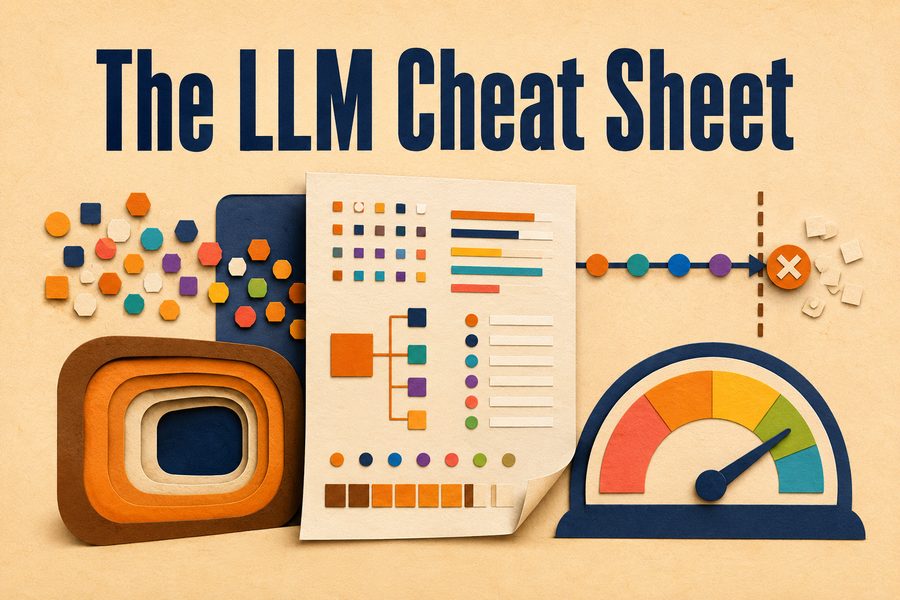
The LLM Cheat Sheet
About this resource
Understanding a little about how these systems work changes how people use them, and it does so more reliably than any amount of prompting advice. Somebody who knows that a model predicts text rather than retrieving facts stops being surprised by a confident wrong answer and starts checking. This one-page reference covers the mechanics of large language models in plain terms.
It defines tokens, context windows, training cutoffs, and the settings that affect how varied or predictable the output is, then explains the consequence of each for daily work. Format matters here: a reference sheet gets kept beside a monitor and consulted, where prose gets read once and filed. This is the page to hand somebody who asks how it actually works and does not want a course.
Long enough to change behavior, short enough that people finish it. Understanding the mechanism does more for output quality than memorizing prompting technique.
How to use it
Print it and keep it. This is a reference rather than a read, and its value comes from being consulted at the moment something surprising happens. Pair it with the glossary: this page explains the mechanism, the glossary explains the vocabulary, and between them a non-technical person can hold their own in almost any AI conversation.
Inside the download
Why these systems generate plausible text rather than looking up facts.
And why it explains length limits, pricing, and odd behavior with numbers.
Why a long conversation starts losing the beginning.
Why a confident answer about current conditions may describe a world that has moved on.
Common questions
They predict likely continuations of text based on patterns learned from a very large body of training material. They are not retrieving facts from a database. That single property explains most of their strengths, including fluency and flexibility, and most of their failures, including confident fabrication.
A token is the unit of text a model processes, roughly three-quarters of a word on average. Tokens explain length limits, how usage is priced, and why models sometimes behave oddly with numbers, spelling, and unusual words: they never see the letters the way you do.
The amount of text a model can consider at once, covering your conversation, any documents supplied, and its own responses. When a long conversation exceeds it, the earliest content stops influencing the answer, which is why a model can appear to forget something you established earlier.
Free. No email list, no follow-up sequence.
More from the resource library, chosen because they pair well with this one.
Plain definitions and why each term matters to somebody running an organization, plus five vendor phrases worth pushing back on.
A task-based comparison of the major assistants, including where the difference matters and where it does not.
Why fabrication happens, where it concentrates, and a detection routine scaled to the stakes.
Tell us a little about yourself and this document is yours. We don't have an email list. We collect this so we know who's finding our resources useful, and that's it.
You're downloading
this document
Your information is kept confidential and never shared with anyone.