Prompting & Everyday Use Decision Tree

The Answer Was Disappointing. What Do You Change First?

Prompt Improvement Flowchart

Free PDF Updated The Jonesi Consultancy
Prompt Improvement Flowchart For All Staff Troubleshooting
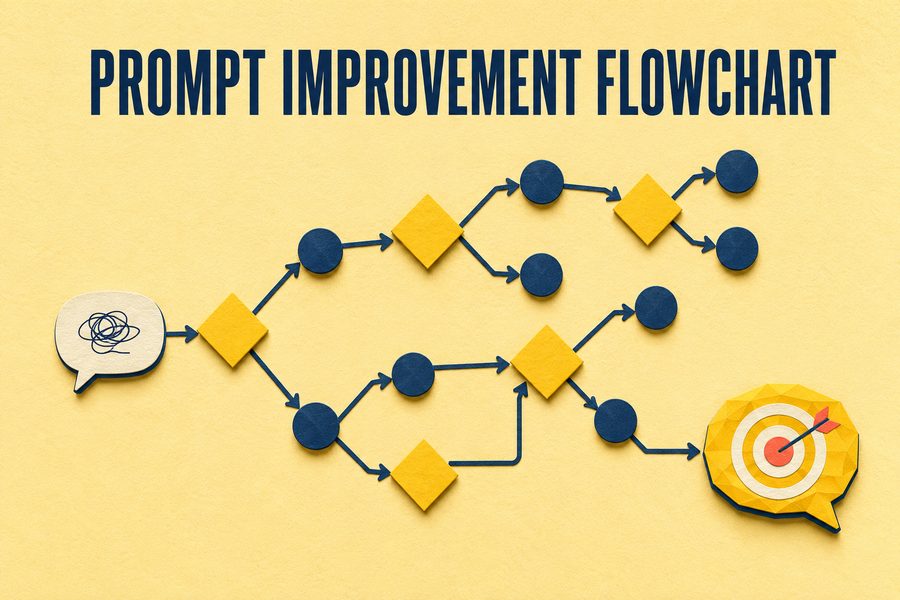
Prompt Improvement Flowchart cover image
Download the Free PDF

Free. No email list, no follow-up sequence.

About this resource

What this guide covers

When an AI response disappoints, most people rewrite the whole prompt and hope. That works occasionally and teaches nothing, because you never learn which change was the one that mattered. This flowchart replaces guessing with diagnosis: identify the symptom, follow the branch, and apply the single change most likely to fix it.

The branches cover the recognizable failure shapes. Too generic usually means missing context. Wrong format usually means the format was never specified. Wrong tone usually means no audience was named. Confidently wrong means the task needed information the model does not have. Too long, too shallow, or off-topic each have their own path. Working through it a few times builds the diagnostic instinct, at which point you stop needing the page.

Change one thing and observe. Rewriting the whole prompt fixes the immediate problem and teaches you nothing about which adjustment did the work.

How to use it

Purpose, and how this will help

Keep it open the next three times you get a disappointing answer. The point is not the flowchart, it is the habit of changing one variable and observing the effect, which is how you build a real sense of what these tools respond to. After a handful of passes most people can skip straight to the fix.

Inside the download

What you'll take away

1

Diagnose by symptom

Start from what actually went wrong rather than from a list of best practices.

2

Fix generic output

The context that was missing, and how much of it to add.

3

Fix format problems

Why the model produced an essay when you needed a table.

4

Fix tone problems

Naming the audience rather than describing the tone you want.

Who this is for

  • Anyone getting inconsistent results and unsure why
  • Managers coaching a team member through better prompting
  • Trainers who need a troubleshooting aid for a workshop
  • Teams standardizing how they improve prompts

Common questions

Frequently asked

How do you fix a bad AI response?

Diagnose before rewriting. If the answer was generic, context was missing. If the format was wrong, you did not specify it. If the tone was wrong, you did not name the audience. If it was confidently wrong, the task required information the model does not have. Change one thing and observe, rather than rewriting everything at once.

Why does AI give generic answers?

Because the prompt gave it nothing specific to work with, so it produced the average of everything it has seen on the topic. Adding two or three sentences of real context about your situation, audience, and constraints usually resolves it in a single pass.

When is the problem the task rather than the prompt?

When the work requires current information, exact recall of specifics, genuine arithmetic, or knowledge of your organization the model was never given. No amount of prompt refinement fixes a task the tool structurally cannot do; supply the information or change the approach.

Download the Free PDF

Free. No email list, no follow-up sequence.

Keep Reading

Related Resources

More from the resource library, chosen because they pair well with this one.