What Are These Tools Genuinely Good At, and Where Do They Reliably Fail?

AI Strengths vs Weaknesses

Free PDF Updated The Jonesi Consultancy
AI Capabilities Limitations For Leaders Decision Aid
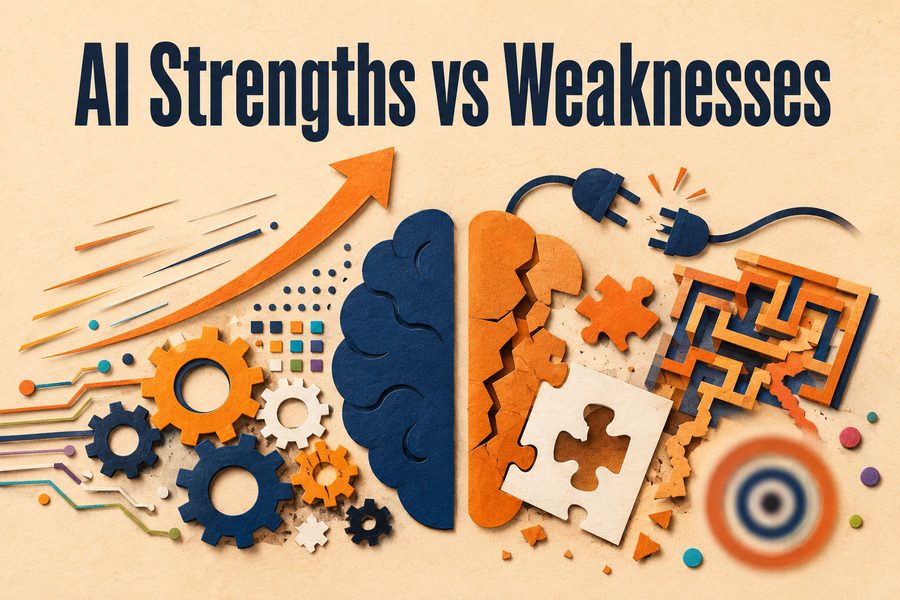
AI Strengths vs Weaknesses cover image
Download the Free PDF

Free. No email list, no follow-up sequence.

About this resource

What this guide covers

The most expensive AI decisions come from applying these tools to the wrong category of work. They are extraordinarily good at some things and structurally poor at others, and the boundary is not intuitive. This one-page map sets AI strengths and weaknesses side by side so the judgment can be made before a task is assigned rather than after the output disappoints.

Strengths cluster around transformation, synthesis, and first drafts. Weaknesses cluster around anything requiring current information, exact recall of specifics, genuine arithmetic, knowledge of your organization, or accountability for a decision. Knowing which side a task falls on is most of the skill, and it transfers between tools in a way that prompting technique does not.

Almost every disappointing AI result traces back to a task from the right column being handed to a tool that only performs well on the left.

How to use it

Purpose, and how this will help

Use it as a filter before you commit anything. When somebody proposes an AI application, find the task on this page first. If it sits in the right column, the answer is not necessarily no, but it does mean the human contribution has to be designed in rather than assumed.

Inside the download

What you'll take away

1

Know the real strengths

Transformation, synthesis, drafting, and structuring, where these tools are genuinely strong.

2

Know the hard limits

Current information, exact recall, arithmetic, and anything about your own organization.

3

Understand the reason

Why each weakness exists, so the boundary is memorable rather than arbitrary.

4

Assign work correctly

Decide before delegating a task rather than after the output disappoints.

Who this is for

  • Leaders deciding which processes are realistic AI candidates
  • Managers assigning AI-assisted work to a team
  • Anyone whose first attempts produced disappointing results
  • Trainers explaining why some tasks work and others do not

Common questions

Frequently asked

What is AI actually good at?

Transforming material you supply, summarizing long documents, drafting first versions, restructuring content for a different audience, generating options, explaining concepts at different levels, and finding patterns across text. All of these share a property: the source material is present rather than recalled.

What are the limitations of AI tools?

Anything requiring information after its training cutoff, exact recall of specifics such as figures and citations, reliable arithmetic, knowledge of your organization that it was never given, and accountability for a decision. It will produce confident output in all of these categories anyway, which is what makes them dangerous rather than merely limiting.

When should you not use AI for a task?

When being wrong is expensive and you cannot verify the output, when the task requires information the model has no access to, when a qualified professional judgment is legally or ethically required, and when the value of the work is the thinking rather than the artifact.

Download the Free PDF

Free. No email list, no follow-up sequence.

Keep Reading

Related Resources

More from the resource library, chosen because they pair well with this one.