Prompting & Everyday Use Annotated Worksheet

What Are the Parts of a Prompt, and Which Ones Are You Leaving Out?

Anatomy of a Great Prompt

Free PDF Updated The Jonesi Consultancy
Prompt Anatomy Annotated Example For All Staff Worksheet
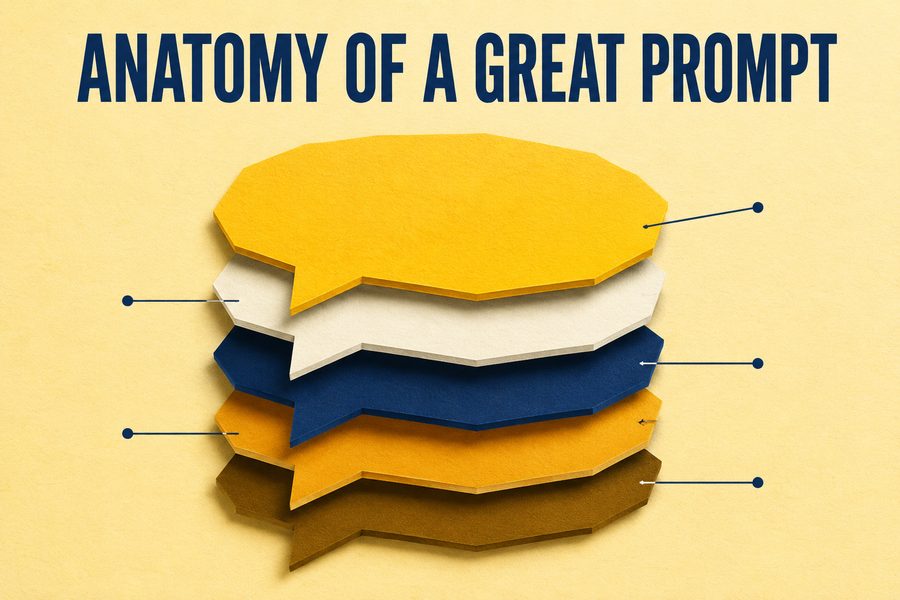
Anatomy of a Great Prompt cover image
Download the Free PDF

Free. No email list, no follow-up sequence.

About this resource

What this guide covers

This takes one genuinely strong prompt and pulls it apart, labelling every component and explaining what each one contributes. Where 6 Techniques shows before-and-after pairs and CRAFT gives you a mnemonic, this shows the anatomy of a prompt as a single annotated specimen, which is a different way of learning the same territory and suits people who need to see the whole before the parts.

The labelled components cover role, context, task, constraints, format, examples, and the success criterion. The second half is a build-your-own section with the same labels blank, so you construct one for a task you actually have. The point of the annotated format is that you can see how much is missing from a typical prompt at a glance rather than being told.

A typical workplace prompt contains two of them. Seeing all seven labelled on one specimen makes the omissions obvious in a way that a list of tips does not.

How to use it

Purpose, and how this will help

Take a prompt you wrote this week and hold it against the labelled specimen. Most workplace prompts contain the task and nothing else, and seeing the six missing components labelled beside your own is more persuasive than any amount of advice about being specific. Then use the blank half to rebuild that same prompt properly.

Inside the download

What you'll take away

1

See all seven parts

Role, context, task, constraints, format, examples, and success criterion, labelled on one specimen.

2

Spot your own omissions

Compare a prompt you wrote this week against the labelled version.

3

Understand what each adds

Not just that a component belongs, but what changes when it is present.

4

Learn the ordering

Why context before task and constraints before format produces better results.

Who this is for

  • People who learn better from a labelled example than from rules
  • Trainers running a hands-on prompting exercise
  • Teams building their first shared prompt templates
  • Anyone whose prompts are one line long

Common questions

Frequently asked

What are the components of a good prompt?

Role, context, task, constraints, output format, worked examples, and a success criterion. Not every prompt needs all seven, but most workplace prompts contain only the task, which is why the results come back generic.

What order should the parts of a prompt go in?

Context before the task, so the model interprets the request correctly. Constraints and format after the task, so they are the last thing read. Examples near the end, and for long supplied material, put the instruction after the content rather than before it.

How long should a prompt be?

Long enough to contain what the model cannot infer, and no longer. Most disappointing prompts are too short rather than too long. Length itself is not the goal: a prompt is finished when a competent stranger could carry out the request from it without asking you a question.

Download the Free PDF

Free. No email list, no follow-up sequence.

Keep Reading

Related Resources

More from the resource library, chosen because they pair well with this one.