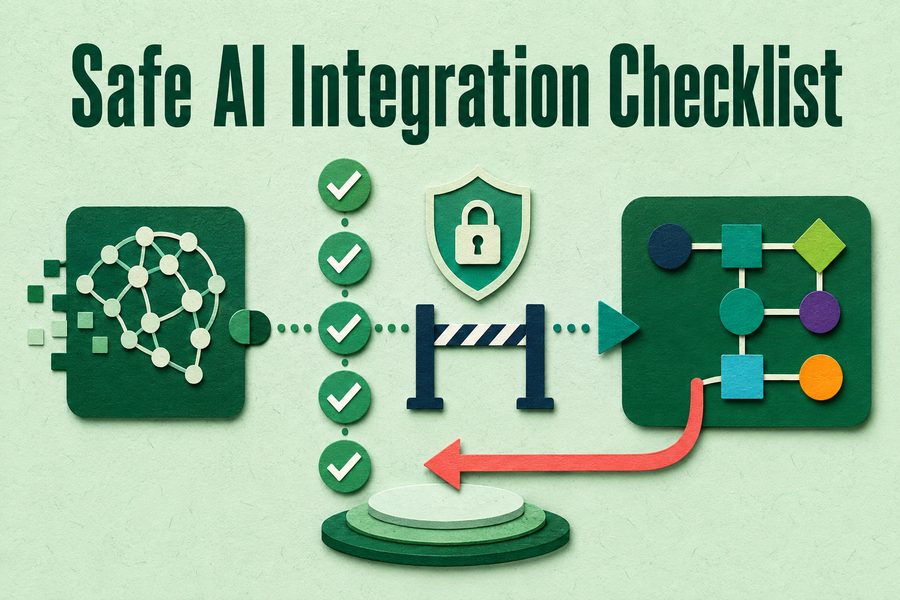
Safe AI Integration Checklist
About this resource
There is a gap between deciding to use an AI tool and having it touch work that matters, and most organizations cross it without a formal check. This one-page checklist is what has to be true before an AI tool becomes part of a live workflow.
It covers data handling and where information will actually sit, access and who can reach the tool, human review points and whether they are meaningful rather than nominal, what the workflow does when the tool is unavailable or wrong, how to roll back, what will be monitored and by whom, and what the affected staff have been told. It is deliberately a checklist rather than a framework, because the format that gets completed is the one that protects you.
Every item is cheaper to settle before go-live than after. The rollback question is the one most often deferred and most expensive to answer late.
How to use it
Run it as a gate rather than as documentation. Every unchecked item is a decision somebody will otherwise make under pressure during an incident, and the rollback item in particular is worth answering while it is still hypothetical. If more than two items cannot be checked, the integration is not ready regardless of how well the pilot went.
Inside the download
Where information goes, how long it stays, and under what terms.
Who can reach it and whether that matches who should.
Whether the human checkpoint involves judgment or a signature.
What the workflow does when the tool is down, which will happen.
Common questions
Where data will sit and under what terms, who has access, whether the human review point involves real judgment, what the workflow does when the tool is unavailable or wrong, how to roll the integration back, what will be monitored and by whom, and whether the affected staff have been told.
Start with a process that is bounded, reversible, and not on the critical path. Keep the previous method available during transition rather than switching cleanly. Define the human checkpoint before go-live rather than adding it after something goes wrong. And capture a baseline first, because you cannot demonstrate the change otherwise.
That depends entirely on whether anyone decided in advance. The workflow needs a defined behavior for the tool being unavailable, for the tool being wrong in a detectable way, and for the tool being wrong in a way nobody notices until later. The third case is the one that requires monitoring rather than a fallback.
Free. No email list, no follow-up sequence.
More from the resource library, chosen because they pair well with this one.
The security questions to put to a vendor before connecting anything to your systems.
A quarterly test of whether governance exists in practice, written as observable conditions.
Why most AI return is undefendable, and the seven questions that have to be settled before any money moves.
Tell us a little about yourself and this document is yours. We don't have an email list. We collect this so we know who's finding our resources useful, and that's it.
You're downloading
this document
Your information is kept confidential and never shared with anyone.